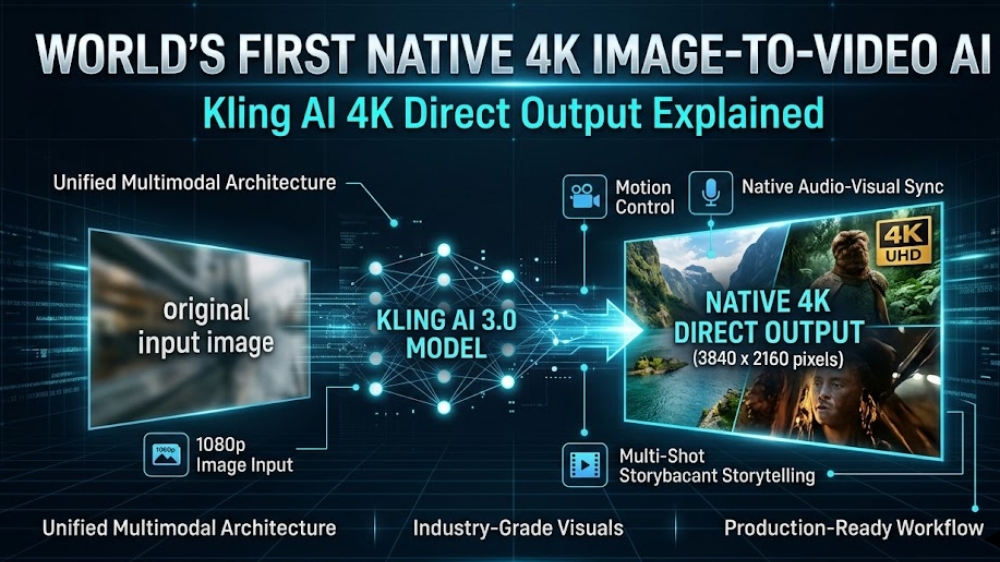
Generating multi-character videos from elaborate imagery is no longer limited to animation studios or blockbuster movie pipelines. With the help of computer vision and neural rendering advances, artificial intelligence (AI) is now able to detect multiple people, comprehend the scene, and produce dynamic, realistic interactions—automatically.
How does AI manage this? The secret is a mix of deep learning, scene parsing, motion synthesis, and cross-disciplinary systems. Let's take a peek at what is going on beneath the surface.
How Does Character Recognition Work in Multi-Character Scenes?
AI systems first identify who or what is in the picture. This is not just a matter of recognizing faces—it's a matter of interpreting body language, spatial relationships, and expressions that imply context.
Technical Principles Of Multi-Character Recognition
1. Pose Estimation and Skeleton Mapping
Therefore, these pose estimation algorithms are utilized by deep learning models in order to detect joints and skeletal structures of every individual. This allows the system to determine whether a person is sitting, standing, running, or socializing with another character.
2. Facial Feature Isolation.
In order to preserve character consistency in video output, the model separates and follows facial landmarks—eyebrows, eyes, nose, lips—through high-resolution segmentation.
3. Instance Segmentation
With instance segmentation, overlapping characters in complex or crowded images are separated by giving each person a different set of pixel groups.
Basic Steps To Create Interactive Videos
1. Detection and Segmentation
The system initially recognizes each character through a multi-step CNN (convolutional neural network) pipeline.
2. Pose Normalization
Characters are remodeled into neutral stances to normalize motion input throughout the video frames.
3. Action Scripting
AI uses behavior prediction models to come up with a sequence of likely actions for every character, frequently based on scene context or prompts.
4. Motion Transfer
With the help of motion capture data or pre-learned motion libraries, the AI animates the characters frame by frame, incorporating fluidity and continuity.
How Do AI Models Interpret Complex Image-Based Scenes?
In order to transcend static images, AI has to infer space, relationships, and implicit narrative—usually from one frame.
Interpretation Of Complex Image Information
1. Depth Estimation
MiDaS or DPT models create a depth map of a 2D image, assigning a Z-axis to every object. It turns 2D flat images into 3D scenes.
2. Contextual Mapping
AI employs contextual clues—shadows, direction of gaze, adjacency of objects—to interpret interactions. For instance, if a child is stretching out to touch a ball, the system infers purposeful movement.
3. Scene Graph Construction
A scene graph is an abstract model of all entities and their interrelations. These graphs allow the system to make decisions based on logic for video flow.
Methods For Creating Dynamic Scenes
1. Neural Radiance Fields (NeRFs)
NeRF-based models recreate photorealistic 3D environments from various viewpoints of a scene or from a single image, with lighting parameters assumed.
2. Generative Adversarial Scripting
GANs (Generative Adversarial Networks) are utilized not just for image refinement but also for developing transitions and background dynamics that facilitate character interaction.
3. Temporal Coherence Layers
AI maintains visual continuity between frames through temporal smoothing so that visual jumps are avoided, particularly in multi-character movement sequences.
How Do Cross-Disciplinary Technologies Integrate with Each Other in Multi-Character Generation?
Producing interactive video from static images demands collaboration across several AI subfields.
Integrating with Natural Language Processing
1. Prompt-to-Action Translation
NLP models interpret user prompts or scene descriptions to produce applicable behaviors. For instance, "two individuals fighting" activates opposing emotional states and gestures.
2. Dialogue Modeling
Characters may be animated with synchronized lip movement and emotional tone from AI-generated scripts using textual prompts.
Combining Image Recognition And Generation Technologies
1. Dual-Pipeline Architectures
A typical architecture is to have one pipeline for pose recognition and image segmentation, and the other for generation and animation. Synchronization of these two is handled through a scene controller module.
2. Attention-Based Fusion
Transformers facilitate the combination of vision and language, allowing models to balance which elements of an image are most important based on the textual or contextual input.
3. Feedback Loops for Refinement
AI systems use discriminator networks to judge video quality during training, feeding errors back into the generator to improve character realism and interaction smoothness.
What Are the Main Challenges in Designing Interactive Multi-Character Scenes?
Making quality scenes from static input is not easy. The complications are multiplied with multiple characters.
Designing Interactions Among Complex Characters
1. Collision Management
When characters animate on their own, they can overlap or clip into each other. Spatial simulation layers are employed to deal with positioning and collision avoidance.
2. Behavior Prediction Across Characters
Every character has to perform not just believably but also react to others. Reinforcement learning allows reactive behavior in video timelines.
3. Synchronization of Motion and Expression
Emotion models direct facial expressions, hand movements, and timing to ensure consistency with implied narrative or text.
Ensuring Video Quality And Scene Authenticity
1. Flicker Reduction
Video flicker due to non-uniform lighting or when poses change is smoothed out by temporal anti-aliasing and inter-frame consistency checks.
2. Audio-Visual Sync.
When speech or sound is present, lip movement, respiration, and facial expressions need to synchronize perfectly to maintain realism.
3. Environmental Physics
Shots involving moving elements—such as falling leaves or moving shadows—need simulation layers that replicate principles of physics in order to heighten believability.
Where Is This Technology Headed and What Industries Will It Affect?
The potential to make interactive videos out of stationary pictures has applications much larger than entertainment.
Possible Applications In The Market
1. Digital Education and Training
Student-uploaded images can be used to create on-the-fly personalized instructors or role-play avatars with realistic behavior specific to learning situations.
2. Advertising and E-Commerce
Retailers can create realistic models that wear several outfits or show products being used, tailored to user-uploaded faces or bodies.
3. Healthcare and Therapy
AI avatars that are designed to emulate family members or caretakers can be comforting, replicate therapy situations, or assist with memory training.
New Opportunities From Innovative Technologies
1. Real-Time Video Production from Surveillance or Photography
Police and investigative industries could reenact possible incident scenes based on available footage or images.
2. Social Media and User Content Platforms
Users may one day upload a group photo and instantly receive a fully animated short story featuring themselves and friends.
3. Game Design and Virtual Worlds
Characters can be auto-generated from concept art or storyboards, reducing development time and enhancing immersion.
FAQs
Q1: Can AI Create a Video with Several Characters from a Single Image?
Yes, it can. Current AI models interpret the image to identify each character, approximate depth, predict movement, and create video frames displaying dynamic interactions. These applications employ pose estimation, motion prediction, and neural rendering to animate every individual separately. The output is a sequence that appears to be a video shot from real-time action, even though it begins with one static photograph.
Q2: Do I Need to Find Different Camera Angles for Improved Results?
Not necessarily. Although several angles do assist in 3D reconstruction, AI these days can generate realistic motion and depth from a single image based on some advanced inference models. Essentially, they utilize learned patterns in data and physics-based models to deduce what's behind or around things.
Q3: How Long Does It Take to Create a Video Featuring Several Characters?
Time is based on complexity. A straightforward interaction between two people can be done in minutes with cloud platforms. More complicated scenes involving lighting, crowd movement, or scripted lines can take hours. GPU acceleration cuts processing time dramatically.
Q4: Can Voices and Expressions Be Added Automatically?
Yes. Through the use of integrated NLP and text-to-speech models, AI is able to provide character-suited voices and sync them with lip movement and facial expressions. Emotional tone can be modulated as well based on the context or user input.
Q5: What’s the Biggest Technical Limitation Right Now?
Scene realism with physical interaction remains challenging. Handshakes, sharing objects, or subtle group dynamics are hard in collision detection, timing, and spatial reasoning. There is active research in enhancing multi-agent physics simulation and narrative coherence.
Final Thoughts
Generating multi-character videos from intricate images is no longer science fiction—it exists, it's scalable, and it's getting better fast. If your business depends on visual content, it's time to look into how these platforms can simplify production, personalize engagement, and inspire new possibilities for creativity.
Want to see what awesome, AI-powered storytelling can do for your project or business? Take the plunge and start experimenting today with a platform that supports V-powered multi-character creation.